
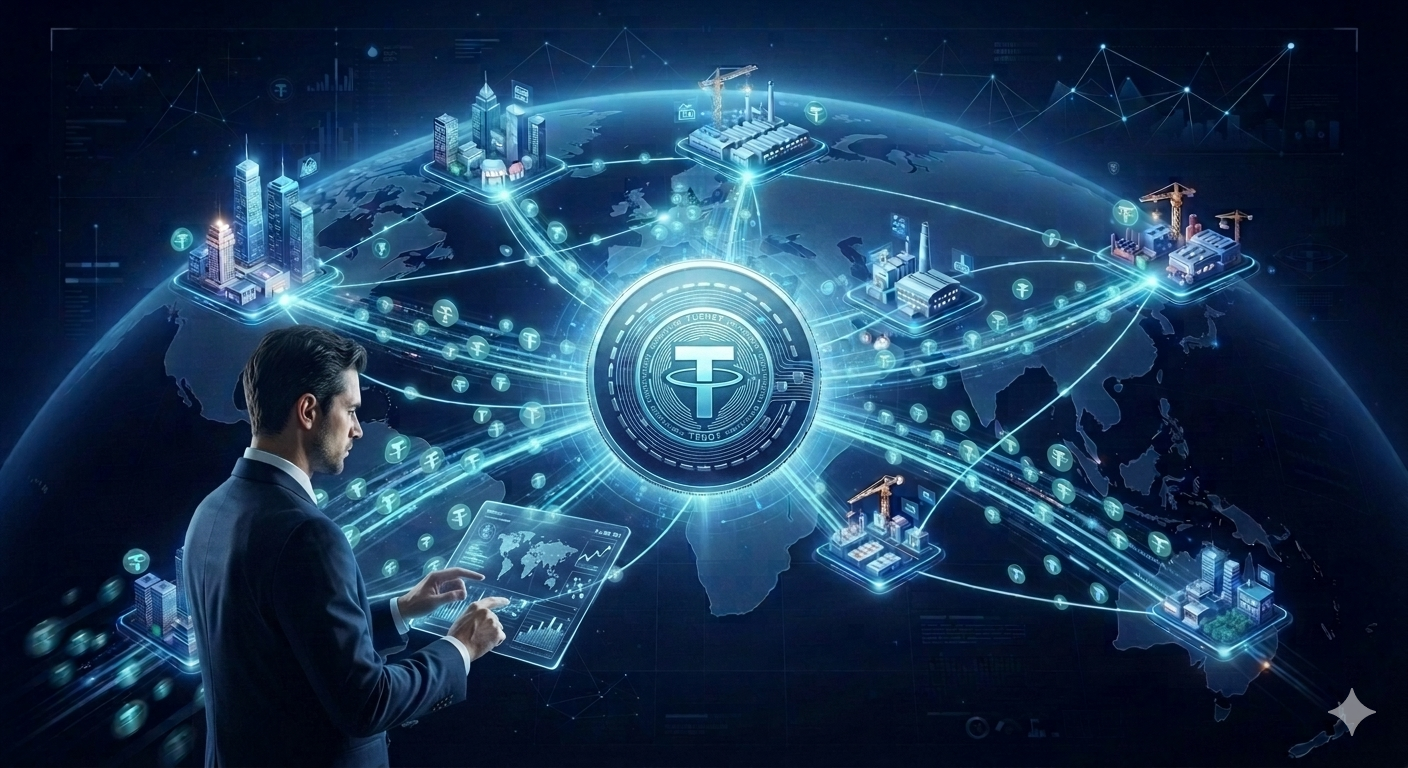
In today’s global environment, one of the main operational challenges for businesses is managing financial assets internationally, especially as they scale globally. Faced with this problem, many companies seek payment alternatives that are fast, cost-effective, and secure. In this context, Tether (USDT) has emerged as an effective solution for domestic and international payments, as it is 1:1 backed by the US dollar and offers the stability of a fiat currency while leveraging the advantages of blockchain technology.
However, the massive institutional adoption of USDT is not without technical and regulatory complexities that organizations must rigorously evaluate. Below, we will learn about the main advantages and disadvantages of Tether payments for businesses.
Cross-border settlement speed
The ability to manage payments quickly and efficiently (regardless of geographic borders) is one of the most critical factors for global financial operations, as it directly impacts the organization’s cash flow and operational capacity and influences the level of satisfaction of international suppliers.
Regarding processing times, there is a clear advantage to using USDT, as it enables practically instant settlement 24/7, completely eliminating reliance on banking business hours and local fees. On the other hand, the disadvantage of USDT is that it depends on its parent company (Tether Limited), and its speed may be “slightly” affected by the level of transactional congestion on the chosen blockchain network (Tron, Ethereum, Solana, Avalanche, etc.); for example, “activity spikes” on the Ethereum network (ERC-20) can cause delays in some operations.
For example, a Delivery app that needs to pay thousands of couriers across different time zones during a “peak demand spike” on a weekend can use USDT to ensure funds arrive quickly, effectively, and without interruption, maintaining the business’s operational continuity without relying on banking hours.
Cost structure and fees in mass processing
“Traditional” cross-border financial operations generally apply percentage fees and fixed costs to each intermediary involved in the payment process, significantly reducing the profit margins of companies with high commercial volumes.
In the case of Tether, transaction fees on blockchain networks are fixed and more affordable, especially compared to the percentage charges levied in traditional banking networks for international operations. However, there is a disadvantage: the unpredictable variability of gas fees during periods of blockchain network congestion can complicate the precise calculation of fixed operating costs, especially if the company lacks an optimized payment channel to mitigate these fluctuations.
For example, a services Marketplace with several freelancers and hundreds of payments to developers and designers across more than 10 countries can unify its operations by drastically reducing the unit cost per transaction, thereby preserving its profit margins.
Stability against currency volatility
The extreme volatility that characterizes traditional cryptocurrencies (such as Bitcoin and Ethereum) introduces financial and operational risk for the finance departments of companies operating in multinational environments.
In terms of stability, Tether (USDT) has the advantage of maintaining “one-to-one” parity with the US dollar, eliminating immediate exchange rate risk and providing indispensable fiscal predictability for the corporate balance sheet. On the other hand, its disadvantage is that companies can depend heavily on the situation of the asset’s issuer (Tether Limited), and there may be “slight” variations in its 1-to-1 ratio with the US dollar, which requires continuous monitoring of USDT reserve audits to guarantee the security of their financial assets.
For example, a global online gaming company with thousands of users across multiple geographic regions can settle and consolidate its corporate balances in USDT, ensuring predictable value and minimizing asset losses from unforeseen cryptocurrency market fluctuations.
Technical integration and operational automation
The implementation of massive digital payment systems entails a profound transformation of companies’ IT architecture, compelling the migration of legacy systems to automated connectivity environments.
Regarding IT efficiency, the use of Tether facilitates automation by enabling outstanding scalability through direct API connections and structured batch processing of large files in standard formats, overcoming the physical limitations of conventional banking. However, this integration requires certain knowledge of the crypto ecosystem, advanced cryptographic key management, and the development of transactional routing architectures, especially to avoid failures in mass shipments.
For example, an international affiliate marketing network that manages thousands of monthly commissions for content creators can program its logical flows to execute these massive transfers simultaneously, automating the payment process with minimal operational effort.
Regulatory compliance and risk prevention
The need to guarantee the legitimate origin of funds and to comply with international financial regulations is a legal standard that affects all companies with high volumes of operations.
Regarding regulatory compliance, Tether provides effective, immutable transaction traceability directly on the blockchain. This generates a public and verifiable record that facilitates real-time audit processes.
However, one of its main disadvantages is the growing complexity of the international regulatory framework, which is constantly evolving. This forces companies to implement complementary technological solutions to comply with anti-money laundering and counter-terrorism financing (AML/CFT) regulations.
For example, an Online Casino with an international license that makes thousands of prize payments can improve its regulatory compliance by automatically verifying that none of the receiving wallets are linked to illicit activities using AML filtering tools before authorizing the release of funds.
Accounting reconciliation and operational visibility
Account reconciliation and verification of financial movements at the close of business days are critical to maintaining accounting health and transparency in organizations with high volumes of financial operations.
In the reconciliation process, using USDT payments provides a notable advantage: transaction records in the block explorer are available instantly and serve as public, definitive proof of payment, minimizing commercial disputes over undelivered transfers. However, the disadvantage of this tool lies in the administrative challenge of unifying these complex digital records within the organization’s traditional systems.
For example, a global marketplace that executes balance validation processes (for more than a thousand suppliers in a single day) can automatically match each service order to its unique identifier, achieving almost instant accounting reconciliation without the information delays of traditional cross-border banking.
Custody security and fraud mitigation
Transactional security and the protection of institutional digital assets require safeguards superior to those in traditional banking.
Tether transfers are immune to malicious chargebacks or countercharges from credit card processors. On the other hand, their operational disadvantage is the absolute irreversibility of blockchain shipments, where a human error in the destination address can result in a loss of capital, forcing companies to implement rigorous multi-signature schemes.
For example, a massive content creator platform seeking to mitigate operational vulnerabilities in its financial management can protect its business flows by migrating the management of its funds from online hot wallets to institutional infrastructure based on offline multi-signature (cold wallet) systems, thereby guaranteeing the permanence and security of capital.
What do you think about this topic? Would you like to learn more about the financial solutions that Smart Bulk Payments offers?
If you are interested in making Tether payments for businesses, you can contact us by visiting the following link.